Whether you drive or not, you have probably heard the news or scrolled through TikTok saying the oil in California is above $5, even $6 per gallon. The impact is huge and real, but have you ever wondered why the war in the Middle East has such a big impact on the oil price?
This is the first article in a series on oil markets — from oil types and pricing to the recent impact. We will talk about some basics for the crude oil.
#What Is Crude Oil? - Oil Types
Crude oil is what is pumped from the ground, but not what we use in daily life. Before we learn about oil pricing, it is important to lay some foundation for different types of crude oil as each type determines the quality and price.
Crude oil is classified by two things: density (API gravity) and sulfur content (sweet/sour).
Density (API gravity) compares oil to water — the higher the API, the lighter the oil.
- Light (API > 34): easier to refine into gasoline or diesel → higher price
- Medium (31–33 API)
- Heavy (API < 30): slower evaporation, used for asphalt, needs more processing
Sulfur content defines how much processing is required:
- Sweet (< 1% sulfur): cleaner, less processing needed
- Sour (1–2% sulfur): requires desulfurization equipment → more costly
For example, US shale oil is primarily light and sweet, featuring a high API gravity (typically 40-50) and low sulfur content (mostly < 0.5%).
#The Three Benchmark Oils
Three benchmarks are widely used in the oil markets. WTI and Brent are the price for light and sweet oil; Dubai/Oman is the price for medium-sour oil. They also come from different origins — WTI from the US, Brent from the North Sea, and Dubai/Oman from the Middle East.
| Benchmark | Origin | Type |
|---|---|---|
| WTI (West Texas Intermediate) | United States | Light, sweet (API 39.6, sulfur 0.24%) |
| Brent | North Sea, Northern Europe | Light, sweet (API 38.3, sulfur 0.37%) |
| Dubai/Oman | Middle East | Medium-sour |
#What Comes Out of a Barrel of Oil? - Petroleum Products
Crude oil is important, but we cannot use it directly in our daily life. It is the raw material, while petroleum products are the usable stuff that comes out of refineries.
When crude oil is heated in a refinery, different products separate out at different temperatures — a process called distillation. Think of it like layers: lighter products like gasoline rise and separate first at lower temperatures, while heavier products like asphalt settle out last. Each layer has a completely different use.
| Product | Used For |
|---|---|
| Gasoline | Cars |
| Diesel | Trucks, ships, trains, construction, agriculture |
| Kerosene | Jets and rockets |
| LPG (propane/butane) | Cooking, heating |
| Fuel Oil (Bunker Fuel) | Large ocean vessels, power plants |
| Asphalt | Roads, roofing |
| Naphtha | Industrial inputs |
(Note: A 42-gallon barrel of crude oil yields about 45 gallons of petroleum products due to processing gain.)
Among all the products, gasoline has become the most popular and plays an important role in the transportation sector as a fuel. That is why flight fuel surcharges and shipping costs increase as crude oil prices rise. Diesel, on the other hand, is the backbone of the global economy and its demand is often used as a proxy for economic activity.
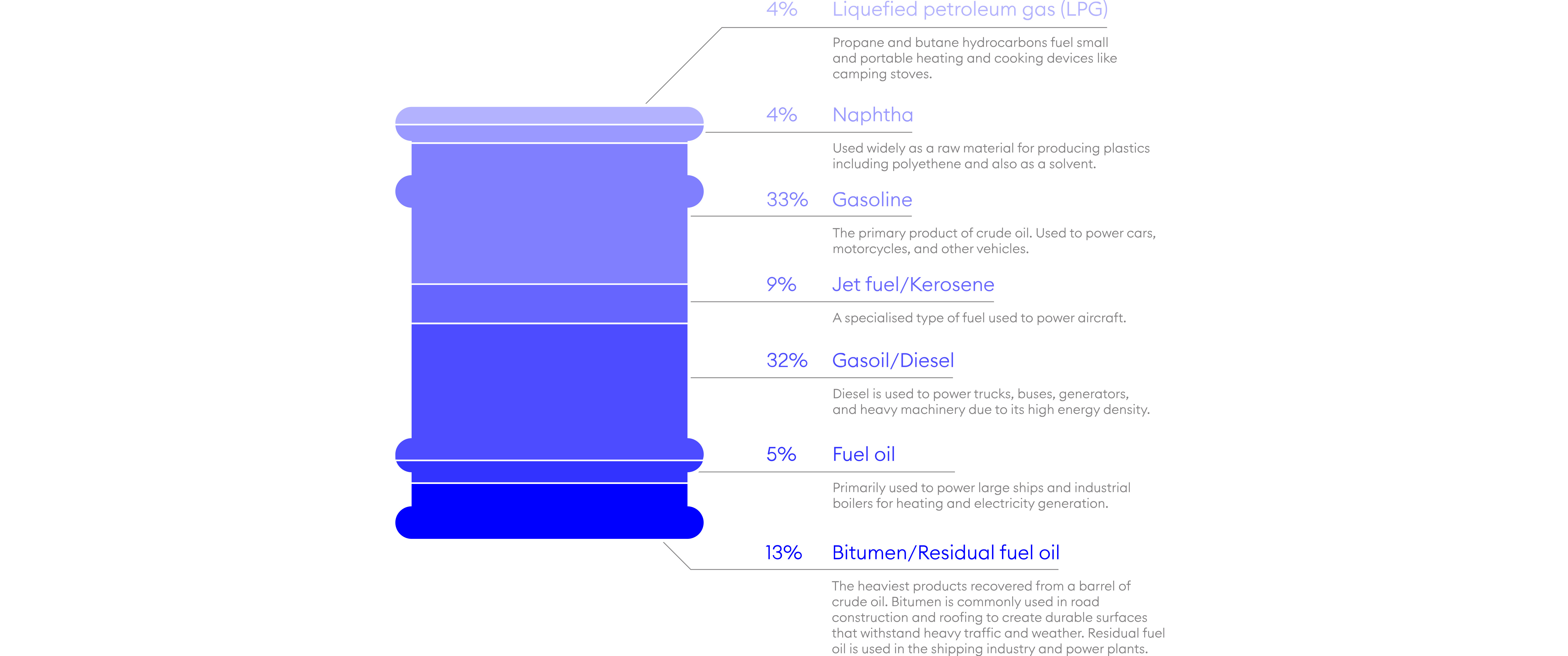 Fig. 1: What a barrel of crude oil produces after refining (Source: Trafigura)
#Who Produces and Consumes Oil? - Supply and Demand
We know that petroleum products are tied to economic activity, so who are the top producers and consumers in the world?
The US, Saudi Arabia, and Russia are the top three oil producers, collectively producing around 40% of global daily output.
The top 10 consuming countries (US, China, India, Saudi Arabia, Russia, South Korea, Japan, Brazil, Canada, Germany) account for roughly 61% of global demand.
#OPEC and OPEC+
It is impossible to talk about oil supply without mentioning OPEC. OPEC (The Organization of the Petroleum Exporting Countries) is a group of 12 major oil-exporting nations: Algeria, Congo, Equatorial Guinea, Gabon, Iran, Iraq, Kuwait, Libya, Nigeria, Saudi Arabia, UAE, and Venezuela.
OPEC countries collectively produce about 35% of the world’s crude oil, and their exports account for around 50% of all oil traded internationally. (Source: EIA) OPEC determines the oil price and is the key player in the oil market.
#How Does Oil Move Around the World? - Trade
The countries that matter most for global oil prices are the ones with the biggest net exports because that’s the oil actually entering the global market.
The US produces 13.5M barrels per day (bpd) but consumes around 20M bpd, so it is actually a net importer. Saudi Arabia produces 9.5M bpd but consumes only around 3–4M domestically — those 6M bpd of net exports are what move global oil prices.
#The Chokepoints
Oil doesn’t flow freely — it travels through a handful of narrow passages called chokepoints, where any disruption can shake global markets. Two of them matter the most.
#Strait of Hormuz
Located between Oman and Iran, the Strait of Hormuz is the gateway out of the Persian Gulf into the Arabian Sea. An average of 20.9M bpd flows through here (1H 2025) — that is 20% of global petroleum consumption and one quarter of all maritime oil trade passing through a single narrow strait.
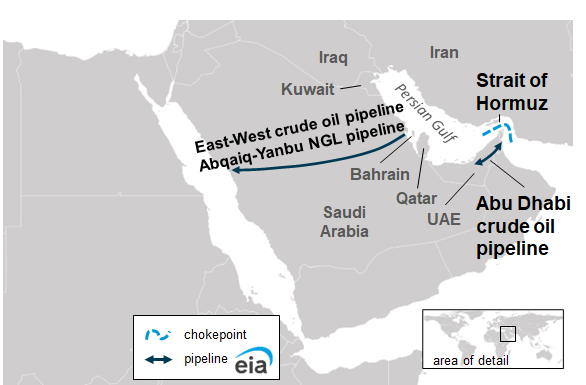 Fig. 2: Daily oil flow through the Strait of Hormuz (Source: EIA)
What makes Hormuz so critical is that there is no good alternative. If the strait were closed, existing alternatives could only reroute a fraction of that volume.
Saudi Arabia sends more oil through Hormuz than any other country, with 89% of it heading to Asian markets — primarily China, India, Japan, and South Korea.
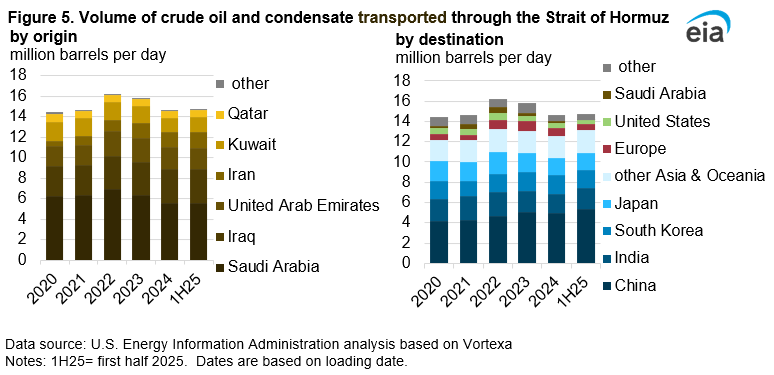 Fig. 3: Top destinations of oil exported through the Strait of Hormuz (Source: EIA)
#Strait of Malacca
If Hormuz is where oil leaves the Middle East, the Strait of Malacca is where it arrives in Asia. Linking the Indian Ocean to the Pacific, it is the main corridor for Middle Eastern oil reaching East Asia — and at 23.2M bpd (1H 2025), it is the largest chokepoint in the world by volume, equivalent to 29% of total maritime oil flows.
 Fig. 4: Daily oil flow through the Strait of Malacca (Source: EIA)
As shown below, the vast majority of oil moving through Malacca originates from the Middle East and flows directly into East Asian economies.
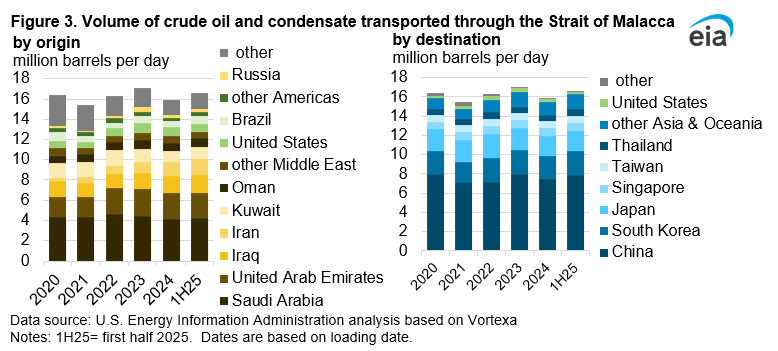 Fig. 5: Origin and destination of oil flows through the Strait of Malacca (Source: EIA)
Now, we have a solid understanding of oil types, their products, global supply and demand, and trade flows. At least we now understand why crude oil prices affect the price of gasoline — and why the top producers, consumers, and chokepoints are all directly relevant to understanding oil pricing. Next, we will move on to pricing — how oil is priced and what drives the price changes.