Money and Banking (1): An Overview of the Financial System
Introduction of Frederic S. Mishkin, The Economics of Money, Banking, and Financial Markets and notes from Chapter 2
The Economics of Money, Banking, and Financial Markets is a great textbook for systematically learning the financial markets and for understanding the entire financial system, from what money is and how interest rates set its price, to how banks and other intermediaries play roles in the market and how the Fed manages the economy.
Financial markets perform the essential function of channeling funds from those who save to those who have a shortage of funds.
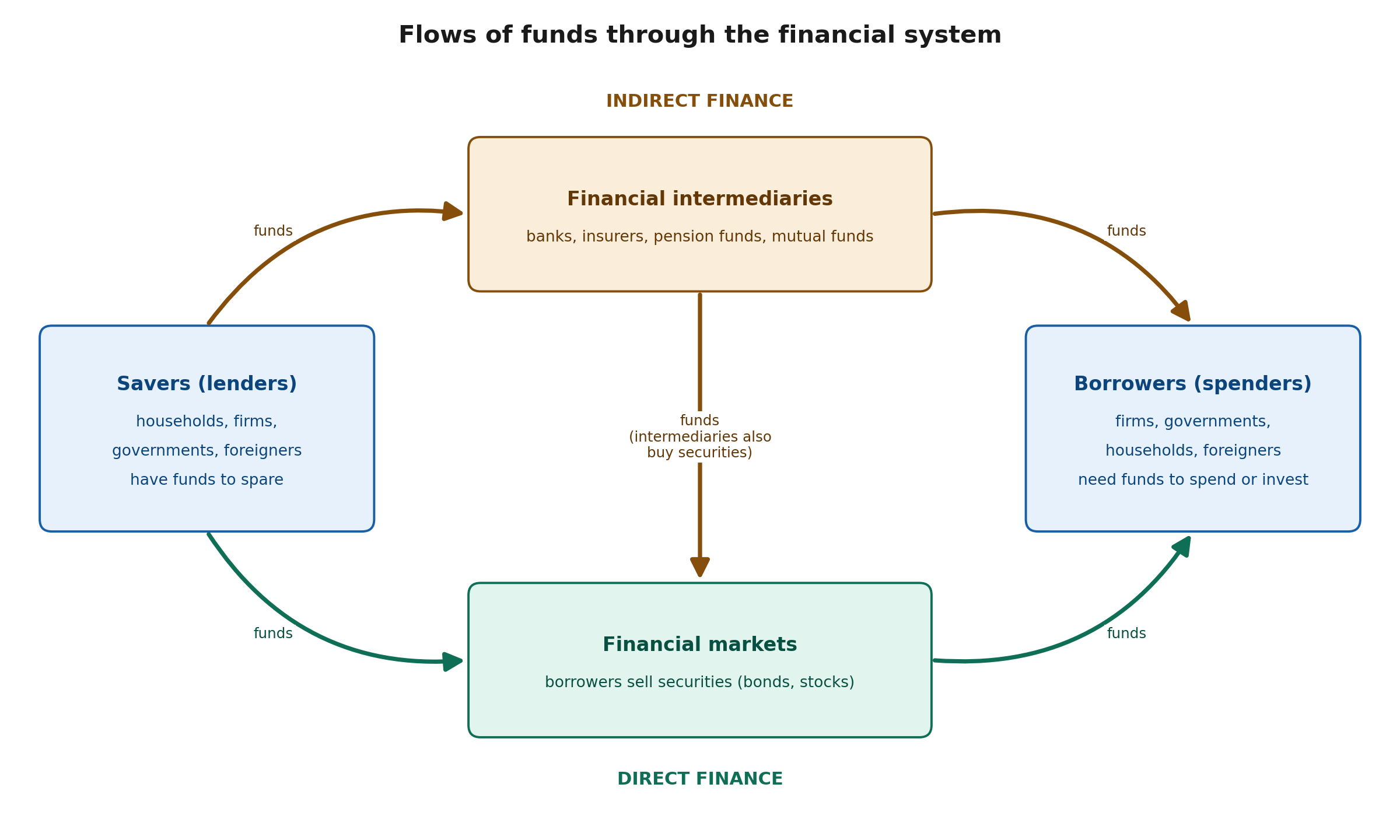
In direct finance, borrowers borrow funds directly from lenders in financial markets by selling them securities (or financial instruments). Securities are claims on the borrower’s future income or assets, which are assets for the people who buy them but are liabilities for those who sell (issue) them.
In the absence of financial markets, it would be hard to transfer funds from a person who has no investment opportunities to one who has them. People would be worse off.
Thus, financial markets are critical for producing an efficient allocation of capital.
Structure of Financial Markets
The following sections illustrate the essential features of these markets.
Debt and Equity Markets
A firm or individual can obtain funds in a financial market in two ways.
The most common method is to issue a debt instrument, such as a bond or a mortgage, which is a contractual agreement by the borrower to pay the holder of the instrument fixed dollar amounts at regular intervals until a specified date, when a final payment is made.
The second method is to issue equities, such as common stock and the assets of a business. Equities often make periodic payments (dividends) to their holders, who also have a right to vote.
The advantage of holding equities is that equity holders benefit directly from any increases in the corporation’s profitability or asset value, while debt holders do not share in this benefit.
Primary and Secondary Markets
A primary market is a financial market in which new issues of a security, such as a bond or a stock, are sold to initial buyers by the corporation or government agency borrowing the funds.
The primary markets are behind closed doors. An investment bank assists the initial sale of securities by underwriting securities - it guarantees a price for a corporation’s securities and then sells them to the public.
A secondary market is a financial market in which securities that have been previously issued can be resold.
NASDAQ and NYSE are the best-known examples of secondary markets. The secondary markets make it easier to sell securities to raise cash and determine the price.
Exchanges and Over-the-Counter Markets
Secondary markets can be organized in two ways.
One method is to organize exchanges, where buyers and sellers of securities meet in one central location to conduct trades.
The other method is to have an over-the-counter (OTC) market, in which dealers at different locations who have securities stand ready to buy and sell securities “over the counter” to anyone who comes to them and is willing to accept their prices. The U.S. government bond market is set up as an over-the-counter market.
Money and Capital Markets
Another way of distinguishing between markets is on the basis of the maturity of the securities traded in each market.
The money market is a financial market in which only short-term debt instruments are traded.
The capital market is the market in which longer-term debt and equity instruments are traded.
Financial Market Instruments
Next, let’s examine the securities traded in financial markets.
Money Market Instruments
U.S. Treasury Bills
U.S. Treasury Bills are short-term debt securities issued by the U.S. government that mature in one year or less. The government pays the face value when a bill matures, and people buy the bill at a discount.
Negotiable Bank Certificates of Deposit
A certificate of deposit (CD) is a debt instrument sold by a bank to depositors that pays annual interest of a given amount and at maturity pays back the original purchase price.
Commercial Paper
Commercial paper is a short-term debt instrument issued by large banks and well-known corporations.
Repurchase Agreements
Repurchase agreements (Repos) are short-term, collateralized loans where an institution sells a security (U.S. Treasury bills or bonds) to an investor for cash and simultaneously agrees to buy it back later at a slightly higher price.
Federal Funds
Federal funds are overnight loans between banks of the deposits they hold at their regional Federal Reserve bank.
Capital Market Instruments
Stocks
Stocks are equity claims on the net income and assets of a corporation.
Mortgages and Mortgage-Backed Securities
Mortgages are loans to households or firms to purchase land, housing, or other real structures. The mortgage market is the largest debt market in the United States.
Mortgage-backed securities are bond-like debt instruments backed by a bundle of individual mortgages, whose interest and principal payments are collectively paid to the holders of the security.
Corporate Bonds
Corporate bonds are long-term bonds issued by corporations with very strong credit ratings.
U.S. Government Securities
U.S. Government Securities are issued by the U.S. Treasury to finance the deficits of the federal government.
U.S. Government Agency Securities
These long-term bonds are issued by various government agencies to finance items like mortgages, farm loans, or power-generating equipment and are backed by the federal government.
State and Local Government Bonds
State and local bonds (municipal bonds) are long-term debt instruments issued by state and local governments to finance expenditures on schools, roads, and other large programs.
Types of Financial Intermediaries
As shown in the figure, funds can move from lenders to borrowers by a second route, called indirect finance. The process of indirect finance using financial intermediaries is called financial intermediation.
Financial intermediaries and indirect finance are so important in financial markets because they can substantially reduce transaction costs and reduce the exposure of investors to risk.
Now, let’s look at the principal financial intermediaries and how they perform the intermediation function.
Depository Institutions
Depository institutions are financial intermediaries that accept deposits from individuals and institutions and make loans.
Commercial Banks
These financial intermediaries raise funds primarily by issuing checkable deposits, savings deposits, and time deposits. Then they use these funds to make commercial, consumer, and mortgage loans and to buy U.S. government securities and municipal bonds.
Credit Unions
These financial institutions are very small cooperative lending institutions organized around a particular group: union members, employees of a firm, and so forth.
Contractual Savings Institutions
Contractual savings institutions are financial intermediaries that acquire funds at periodic intervals on a contractual basis.
Life Insurance Companies
They acquire funds from the premiums that people pay to keep their policies in force and use them mainly to buy corporate bonds and mortgages.
Pension Funds and Government Retirement Funds
The largest asset holdings of pension funds are corporate bonds and stocks.
Investment Intermediaries
Finance Companies
Finance companies raise funds by selling commercial paper and by issuing stocks and bonds. They lend these funds to customers.
Mutual Funds
These financial intermediaries acquire funds by selling shares to many individuals and use the proceeds to purchase diversified portfolios of stocks and bonds.
Money Market Mutual Funds
These financial institutions acquire funds that are used to buy money market instruments that are both safe and very liquid.
Investment Banks
An investment bank helps a corporation issue securities.