Money and Banking (7): Central Banks and the Federal Reserve System
From Frederic S. Mishkin, The Economics of Money, Banking, and Financial Markets — Chapter 13
Central banks, such as the Fed in the U.S., are in charge of monetary policy and are at the center of the news nowadays. This chapter looks at the institutional structure of central banks, particularly the Fed.
Structure of the Federal Reserve System
The Federal Reserve System with its 12 regional Federal Reserve banks was created by the Federal Reserve Act of 1913.
The Federal Reserve System includes the following entities: the Federal Reserve banks, the Board of Governors of the Federal Reserve System, the Federal Open Market Committee (FOMC), the Federal Advisory Council, and member commercial banks.
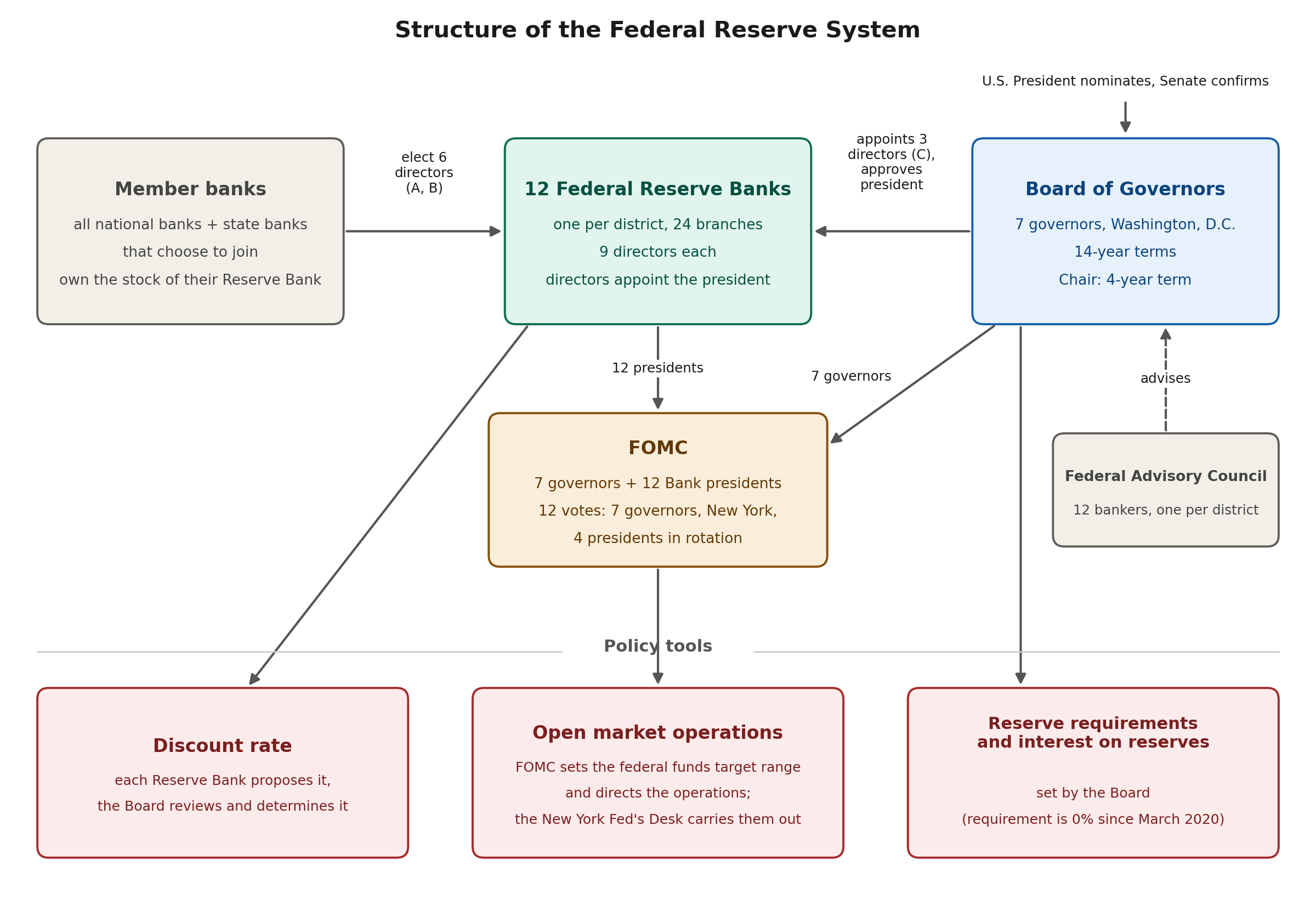
Structure of the Federal Reserve System
Federal Reserve Banks
Each of the 12 Federal Reserve districts has one Federal Reserve bank. Most of them also have branches in other cities of the district, 24 branches in total.
Each Federal Reserve bank is a quasi-public (part private, part government) institution. Its stock is held by the commercial banks in its district that are members of the Federal Reserve System. Member banks are required to buy this stock and receive a dividend on it, but they cannot sell or trade it.
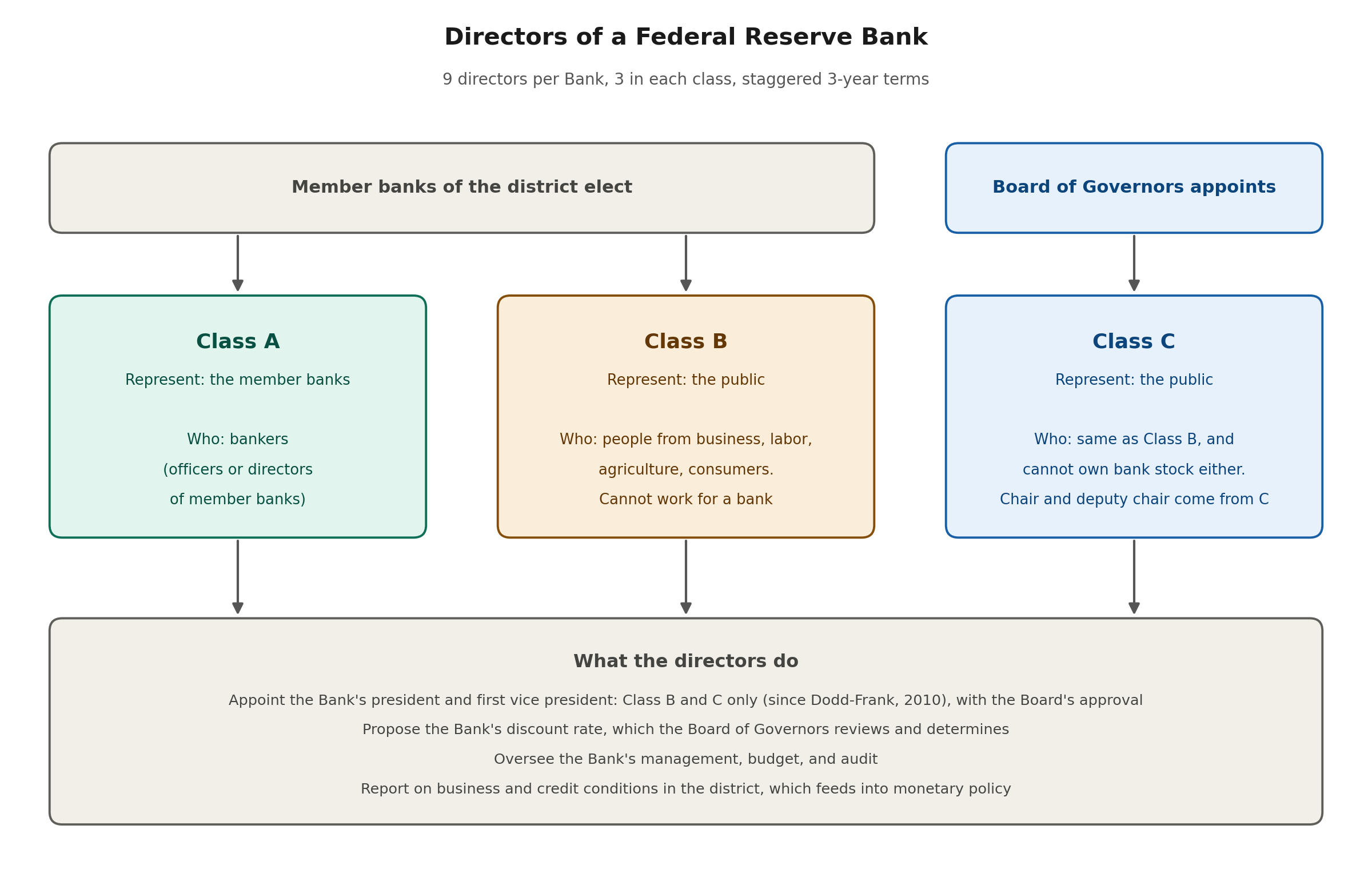
Each Federal Reserve bank has nine directors in three classes, three in each class, serving staggered three-year terms:
- Class A: elected by the member banks of the district. They are professional bankers and represent the member banks.
- Class B: elected by the member banks of the district. They represent the public (business, labor, agriculture, consumers).
- Class C: appointed by the Board of Governors. They represent the public. The chair and deputy chair of the board come from Class C.
The president of each of the 12 Federal Reserve banks is appointed by its Class B and Class C directors and approved by the Board of Governors.
Federal Reserve Banks
Functions of the Federal Reserve banks:
- Clear checks and run the payment systems
- Issue new currency and withdraw damaged currency from circulation
- Make discount loans to banks in their districts
- Examine bank holding companies and state-chartered member banks
The largest Federal Reserve bank is the New York bank. It holds $3.53 trillion of the $6.75 trillion in total assets of the 12 banks, about 52% (as of October 7, 2026). The next largest is San Francisco with about 10%.
Member Banks
All national banks (chartered by the federal government) are required to be members of the Federal Reserve System. Banks chartered by a state may choose to join. More than one-third of U.S. commercial banks are members.
What membership means today:
- A member bank must buy stock in its district Federal Reserve bank.
- The dividend on this stock is 6%. Large member banks (more than $13.2 billion in assets in 2026) receive the lower of 6% and the 10-year Treasury yield.
- Member banks elect six of the nine directors of their Federal Reserve bank (Class A and Class B).
What is the same for members and nonmembers:
- All depository institutions have the same access to the discount window and to Fed services, and earn interest on their reserves.
- The reserve requirement is 0% for all of them (since March 2020).
Board of Governors
The Board has seven governors and sits in Washington, D.C. Each governor is nominated by the president of the United States and confirmed by the Senate.
- Term: 14 years, not renewable. One term begins every two years, so the terms are staggered.
- Chair and Vice Chair: chosen from among the governors for four-year terms that can be renewed.
What the Board does:
- All seven governors vote on the FOMC.
- It sets reserve requirements and the interest rate on reserves.
- It reviews and determines the discount rate.
- It supervises and regulates banks.
Federal Open Market Committee (FOMC)
The FOMC meets eight times a year. It decides on open market operations and sets the target range for the policy interest rate, the federal funds rate: the interest rate on overnight loans from one bank to another.
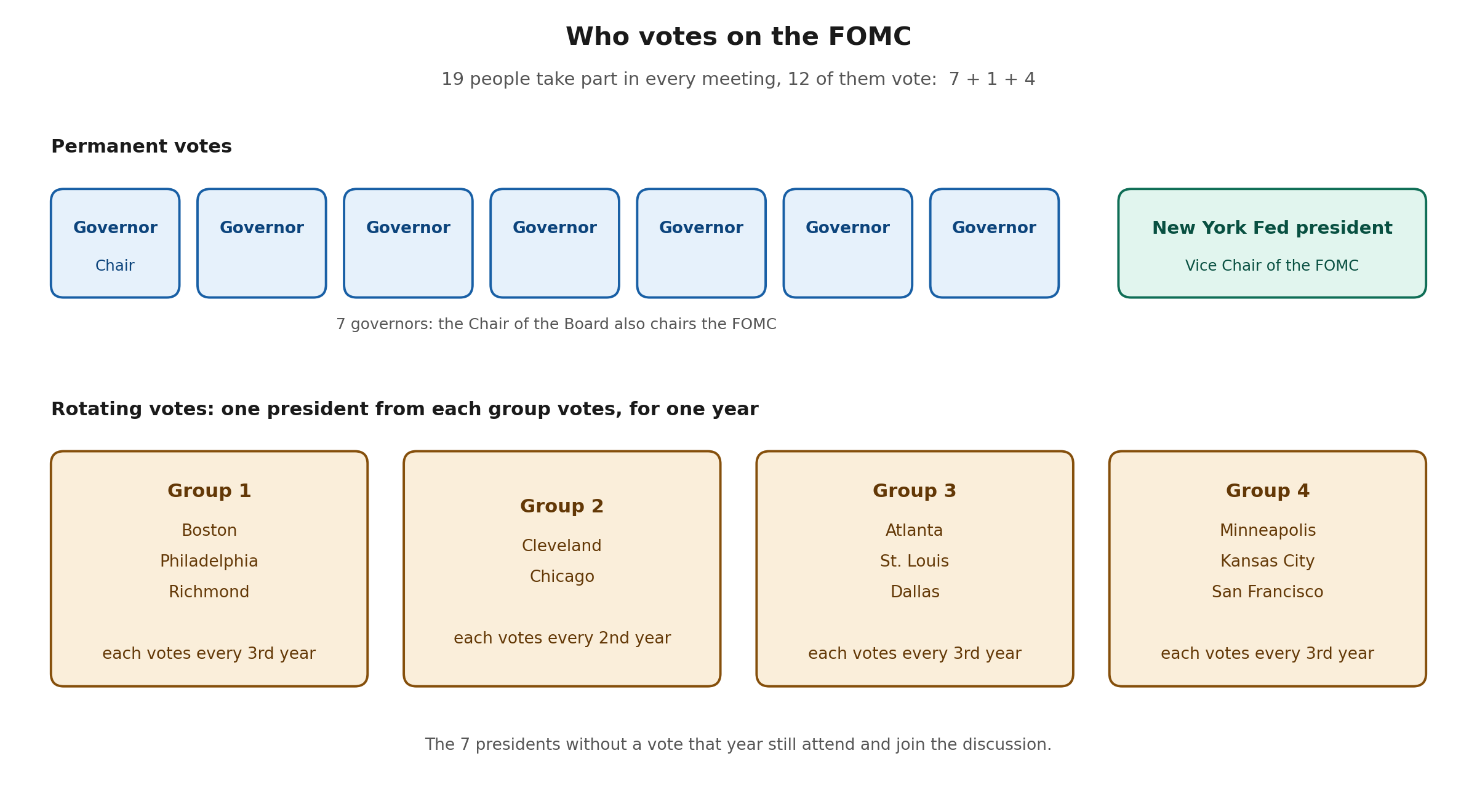
Members. Twelve people vote: the seven governors, the president of the New York bank, and four of the other 11 bank presidents, who rotate in one-year terms. The Chair of the Board is also the chair of the FOMC, and the New York president is its vice chair. The seven presidents without a vote still attend and join the discussion.
Federal Open Market Committee (FOMC)
The meeting. It usually takes two days in Washington, D.C. Four times a year the FOMC publishes its projections, including the dot plot.
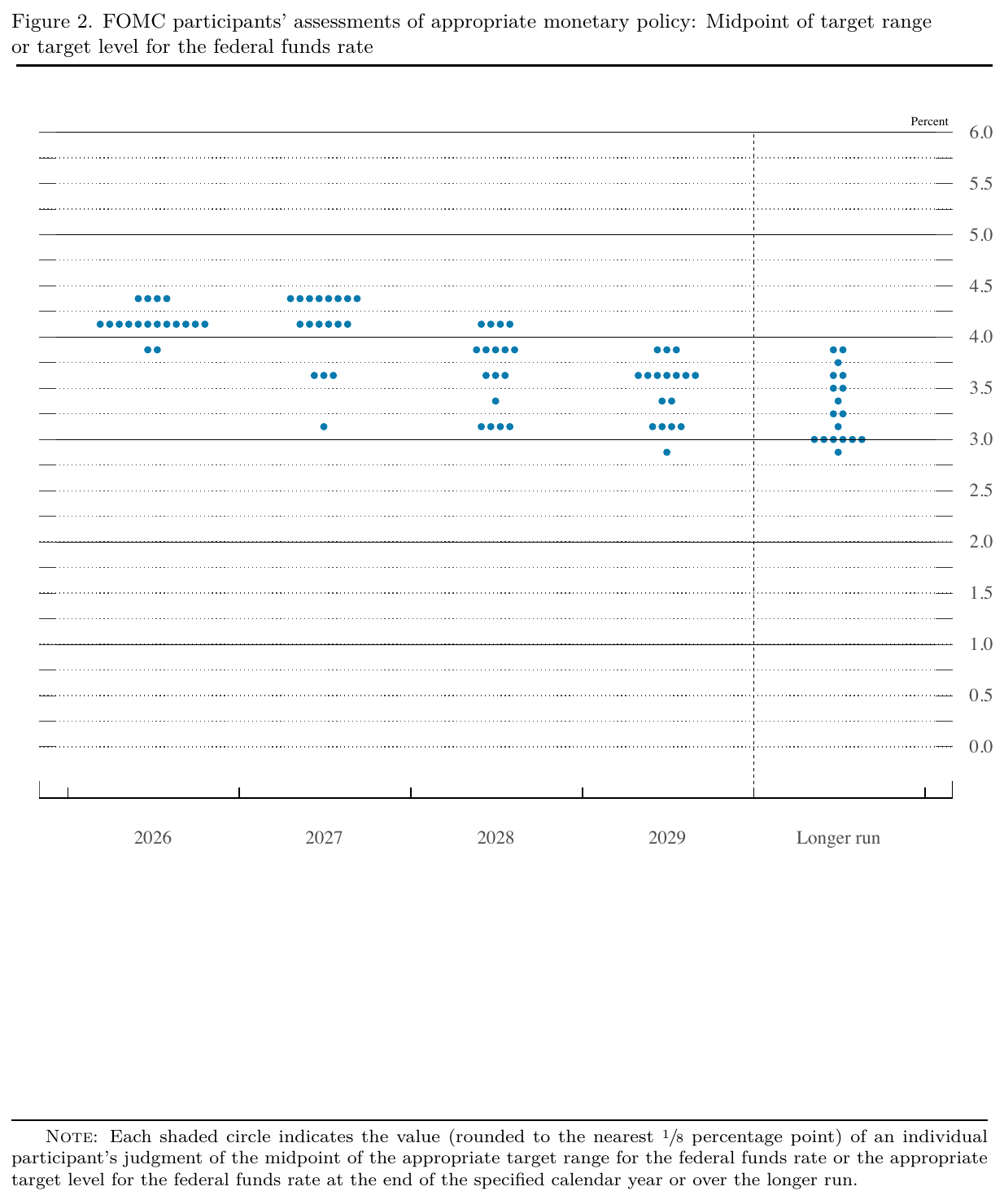
Source: Federal Reserve Board, Summary of Economic Projections, September 16, 2026, Figure 2.
The dot plot shows where each FOMC participant thinks the federal funds rate should be at the end of this year and of each of the next three years, and in the longer run. It is a good way to see where they expect rates to go in the short term and in the long term.
Who trades. The FOMC does not buy or sell securities itself. It directs the Open Market Trading Desk at the New York bank, which carries out the purchases and sales.