Money and Banking (9): Tools of Monetary Policy
From Frederic S. Mishkin, *The Economics of Money, Banking, and Financial Markets* — Chapter 15
In recent years, the Fed has increasingly focused on the federal funds rate. To see how the Fed controls it, let’s examine the tools of monetary policy.
The Market for Reserves and the Federal Funds Rate
We have seen how open market operations and Fed lending affect the balance sheet of the Fed and the amount of reserves. The market for reserves is where the federal funds rate is determined.
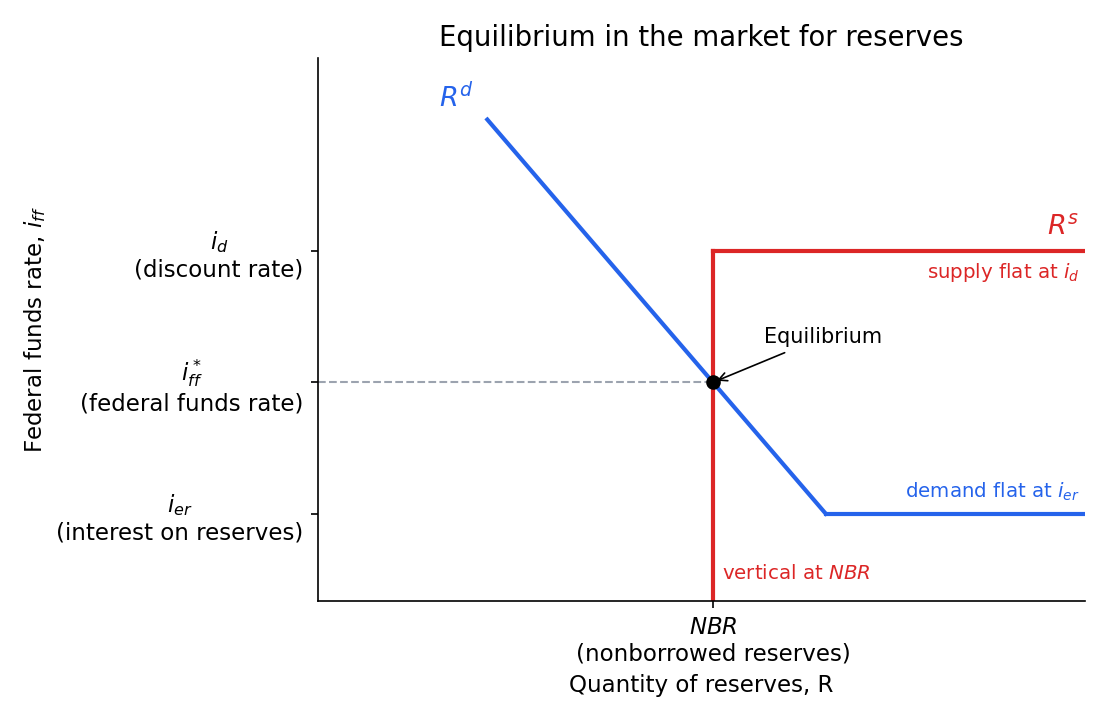
The equilibrium in the market for reserves
On the demand side, the quantity of reserves demanded equals required reserves plus the quantity of excess reserves demanded.
Since October 2008, the Fed has paid interest on reserves. The demand curve for reserves slopes downward until the federal funds rate falls to the interest rate paid on excess reserves. Below that, banks would rather keep adding to their excess reserves than lend in the overnight market at a lower rate, so the demand curve becomes flat.
The supply of reserves can be broken up into two components: the amount of reserves supplied by the Fed’s open market operations, called nonborrowed reserves, and the amount of reserves borrowed from the Fed, called borrowed reserves. The cost of borrowing from the Fed is the discount rate.
As long as the federal funds rate is below the discount rate, banks will not borrow from the Fed and borrowed reserves will be zero. Therefore, the supply of reserves equals the amount of nonborrowed reserves supplied by the Fed, so the supply curve is vertical. If the federal funds rate rises above the discount rate, banks would want to borrow at the discount rate, so the supply curve becomes flat at the discount rate.
Since 2019, the Fed has chosen to keep reserves ample, so the supply curve crosses the flat part of the demand curve and the federal funds rate stays close to the interest rate on reserves. The Fed now moves the federal funds rate by changing the interest rate on reserves, not the quantity of reserves.
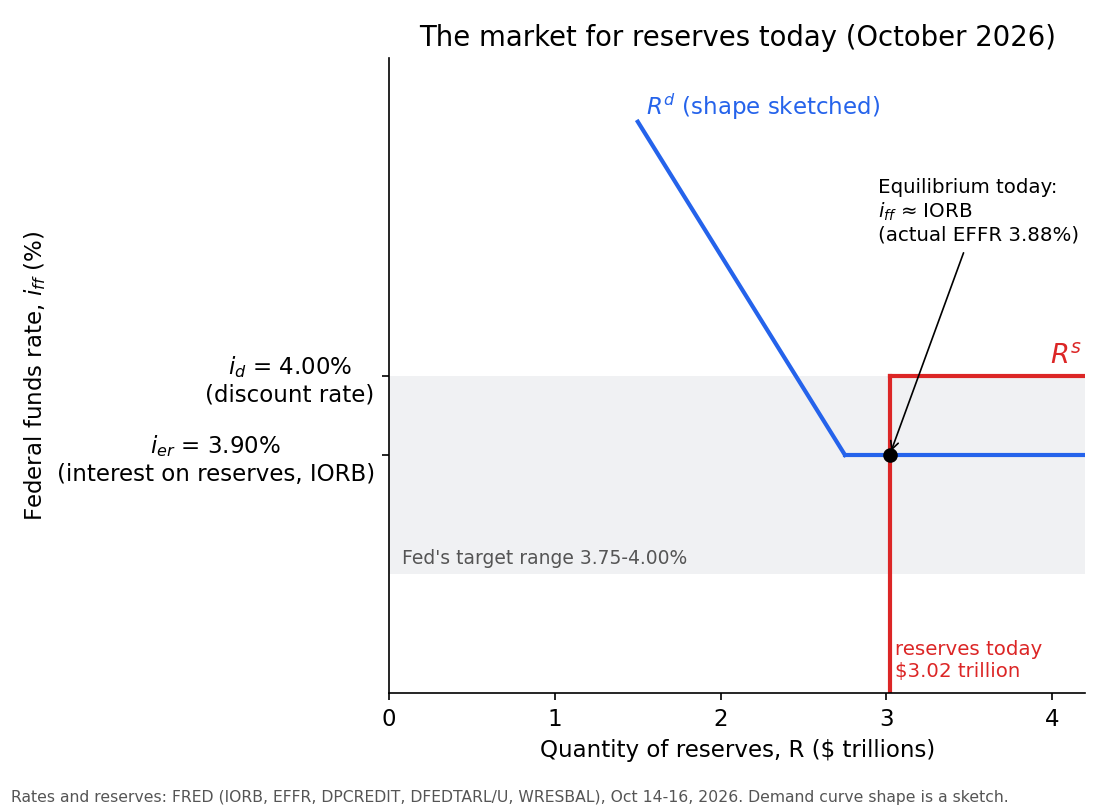
The market for reserves today (October 2026)
Now, let’s check how the tools of monetary policy affect the market for reserves and the equilibrium federal funds rate.
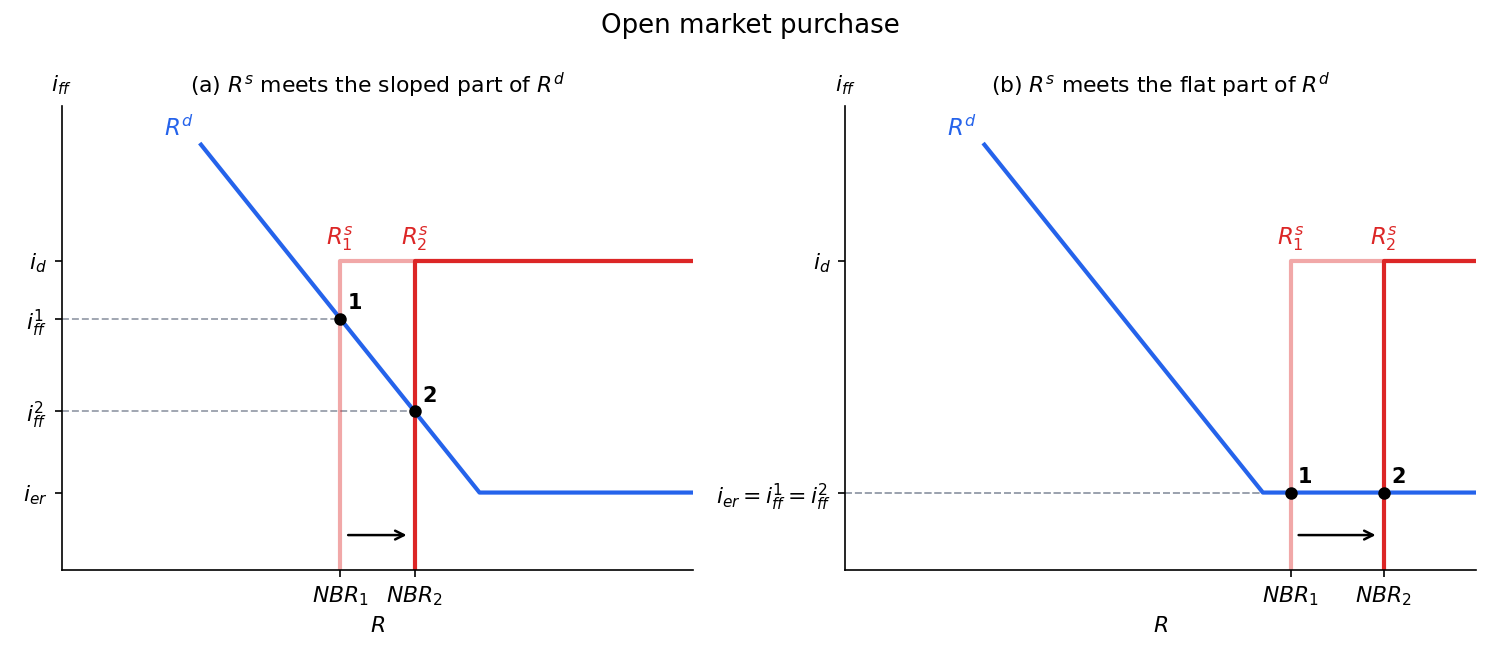
Open Market Operations
An open market purchase causes the federal funds rate to fall, and an open market sale causes it to rise only when the supply curve crosses the sloped part of the demand curve; otherwise, the federal funds rate does not change.
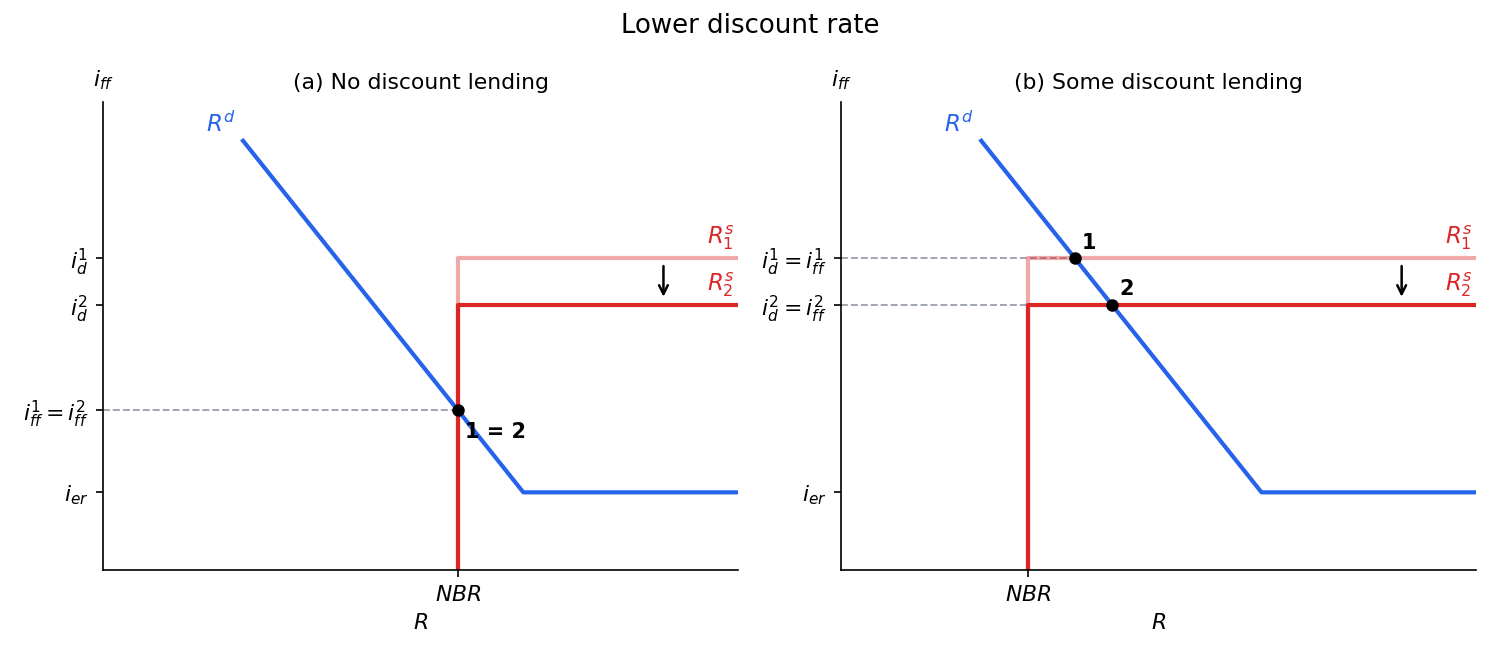
Discount Lending
Lowering the discount rate causes the federal funds rate to fall only when banks are already borrowing from the Fed; otherwise, the federal funds rate does not change.
Reserve Requirements
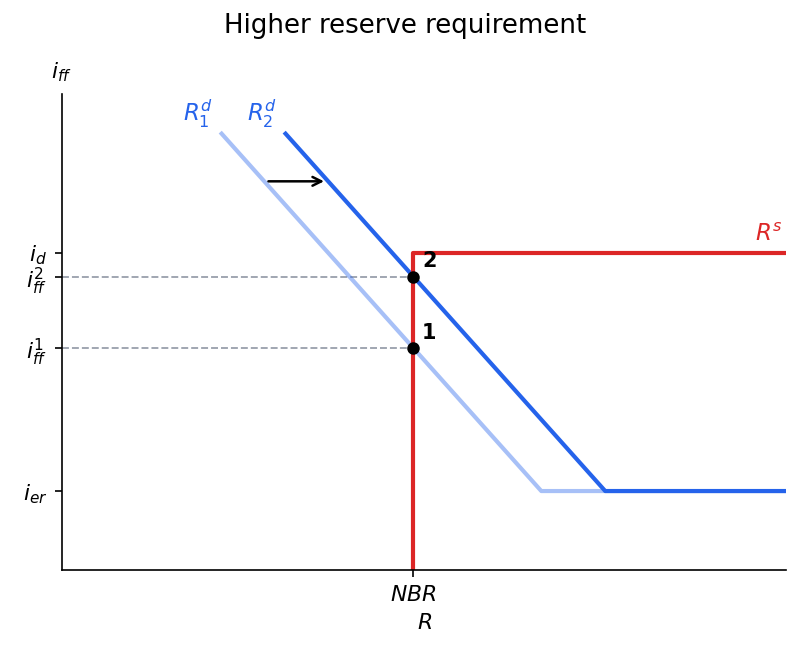
Raising reserve requirements causes the federal funds rate to rise, and lowering them causes it to fall.
Interest on Reserves
Raising the interest rate on reserves causes the federal funds rate to rise only when the supply curve crosses the flat part of the demand curve; otherwise, the federal funds rate does not change.
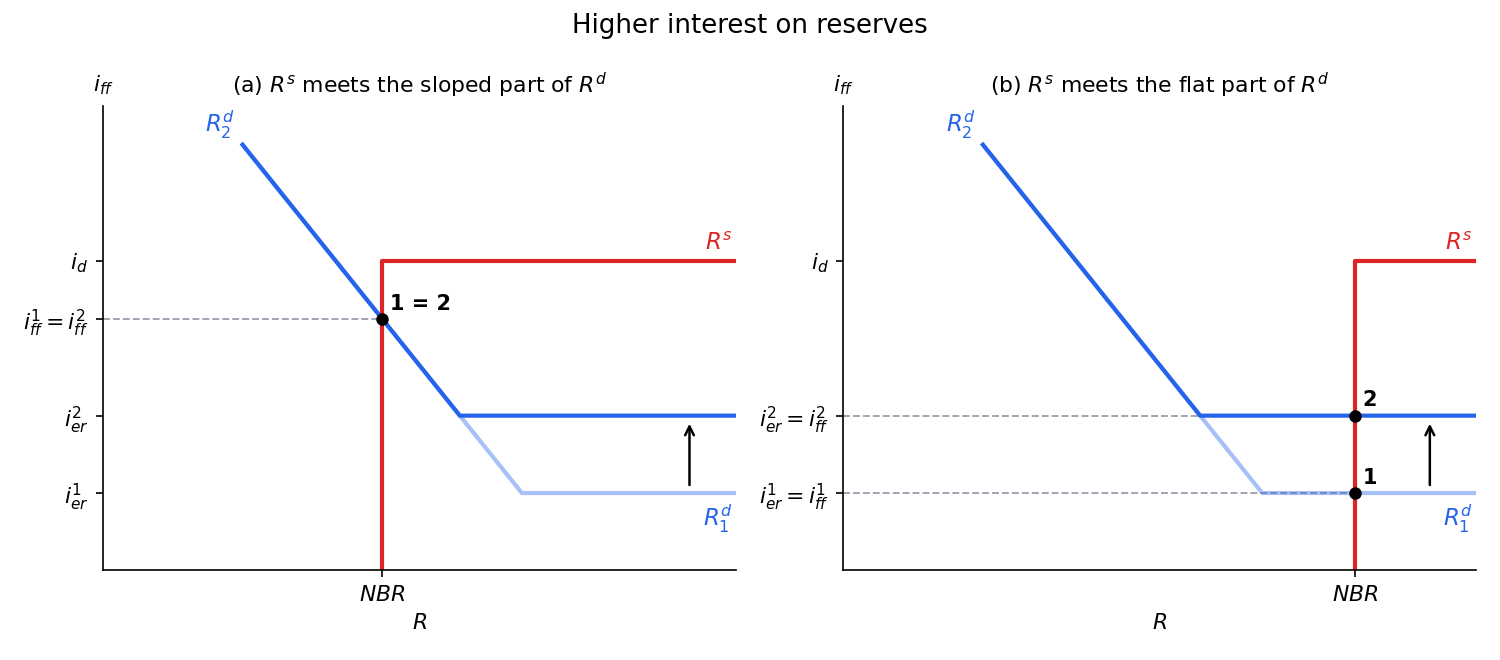
This is what the Fed is using nowadays.
Monetary Policy Tools
We already know the four tools of monetary policy, which are called conventional monetary policy tools. However, during a financial crisis, these tools may no longer be useful, so the Fed uses nonconventional monetary policy tools. We will take a look at both.
Conventional Tools
Open Market Operations
Open market operations are the most important conventional monetary policy tool.
There are two types of open market operations: dynamic open market operations and defensive open market operations.
| Dynamic OMO | Defensive OMO | |
|---|---|---|
| Goal | Change the level of reserves and the monetary base | Offset other factors that move reserves, to keep them steady |
| In the graph | The Fed chooses to shift | Something else shifts |
| Typical form | Outright purchases or sales | Repos and reverse repos (temporary) |
- Repo (repurchase agreement): the Fed buys securities now and sells them back later, so reserves rise temporarily.
- Reverse repo (matched sale–purchase): the Fed sells securities now and buys them back later, so reserves fall temporarily.
- Factors that move reserves without the Fed choosing it: Treasury deposits at the Fed (the TGA) and float.
Discount Policy
The Fed’s discount loans to banks are of three types: primary credit, secondary credit, and seasonal credit.
| Type | Who borrows | How the rate is set (since March 2020) |
|---|---|---|
| Primary credit | Healthy banks, for any reason | Equal to the top of the federal funds target range |
| Secondary credit | Banks in financial trouble | 50 basis points above primary credit |
| Seasonal credit | Small banks in farm or resort areas | Tied to market interest rates |
Discounting is also important in preventing and coping with financial panics as the lender of last resort. It is a very effective way to provide reserves to the banking system during a banking crisis, because reserves are immediately channeled to the banks that need them most.
Reserve Requirements
Changes in reserve requirements affect the money supply by causing the money multiplier to change.
Interest on Reserves
Interest on reserves is a new tool that was introduced in 2008.
Since July 2021, it has been called IORB (interest on reserve balances), paid on all reserves. After QE, reserves were huge. IORB lets the Fed raise rates without selling all those bonds first.
Nonconventional Tools and Quantitative Easing
There are two main reasons why the Fed turns to nonconventional tools. One is the zero-lower-bound problem, in which the central bank is unable to lower short-term interest rates further because they have hit a floor of zero. The other is when the financial system seizes up: lenders can’t tell good borrowers from bad ones, so they stop lending to almost everyone.
Large-Scale Asset Purchases (QE)
In QE, the Fed buys long-term bonds (Treasuries and MBS), not just short-term ones.
Quantitative Tightening (QT)
Quantitative tightening (QT) is the reverse of QE: the Fed lets its securities mature without replacing them, which shrinks its balance sheet and the monetary base.
Liquidity Provision
Liquidity provision is emergency lending by the Fed to financial institutions and markets that cannot get funding during a crisis.
The Fed lends directly to the frozen market, so funds reach borrowers even when lenders have stopped lending. This is the Fed acting as the lender of last resort.
Negative Interest Rates
Negative interest rates are a policy in which the central bank charges banks for holding reserves. The interest rate on reserves is set below zero, which encourages banks to lend instead.
For example, the Bank of Japan (BOJ) kept its policy rate at −0.1% from 2016 to 2024.