Money and Banking (3): Understanding Interest Rates
From Frederic S. Mishkin, The Economics of Money, Banking, and Financial Markets — Chapter 4
Interest rates are among the most closely watched variables in the economy. They influence personal decisions such as whether to consume or save. They also affect the economic decisions of businesses and households.
Different debt instruments have very different streams of cash payments to the holder with very different timing. Thus, understanding how we can compare the value of one kind of debt instrument with another is very important, and we do it with present value.
Present Value
Present value measures what a future sum of money is worth in today’s dollars.
PV is present value and CF is cash flow.
Intuitively, the equation tells us that if you are promised $1 of cash flow
Types of Credit Market Instruments
There are four basic types of credit market instruments.
Simple Loan
The lender provides the borrower with an amount of funds, which must be repaid to the lender at the maturity date along with an additional payment for the interest. For example, commercial loans to businesses.
Fixed-Payment Loan
The lender provides the borrower with an amount of funds, which must be repaid by making the same payment every period, consisting of part of the principal and interest for a set number of years. For example, mortgages, auto loans, student loans.
Coupon Bond
A coupon bond pays the owner of the bond a fixed interest payment every year until the maturity date, when the face value is repaid. For example, Treasury notes and bonds, corporate bonds.
Discount Bond (Zero-Coupon Bond)
A discount bond is bought at a price below its face value, and the face value is repaid at the maturity date. For example, Treasury bills, zero-coupon bonds, U.S. savings bonds.
Yield to Maturity (YTM)
The most important way of calculating interest rates is the yield to maturity.
Yield to maturity (YTM) is the total annual return you can expect from a bond if you buy it at the current market price and hold it until maturity.
YTM is always quoted as an annualized rate, never as a cumulative return.
Simple Loan
For simple loans, the simple interest rate equals the yield to maturity.
Fixed-Payment Loan
Coupon Bond
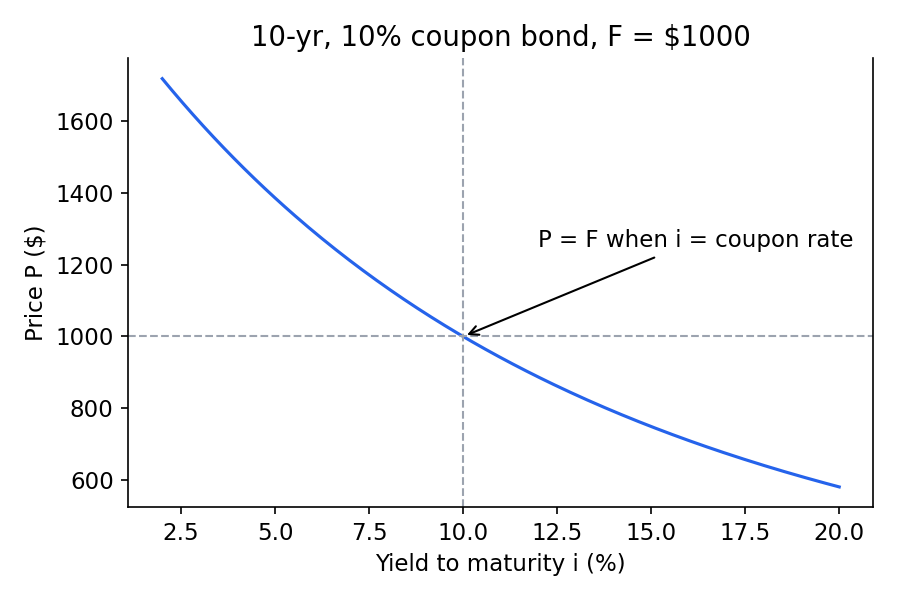
Yield to Maturity: Coupon Bond
Discount Bond
Current bond prices and interest rates are negatively related.
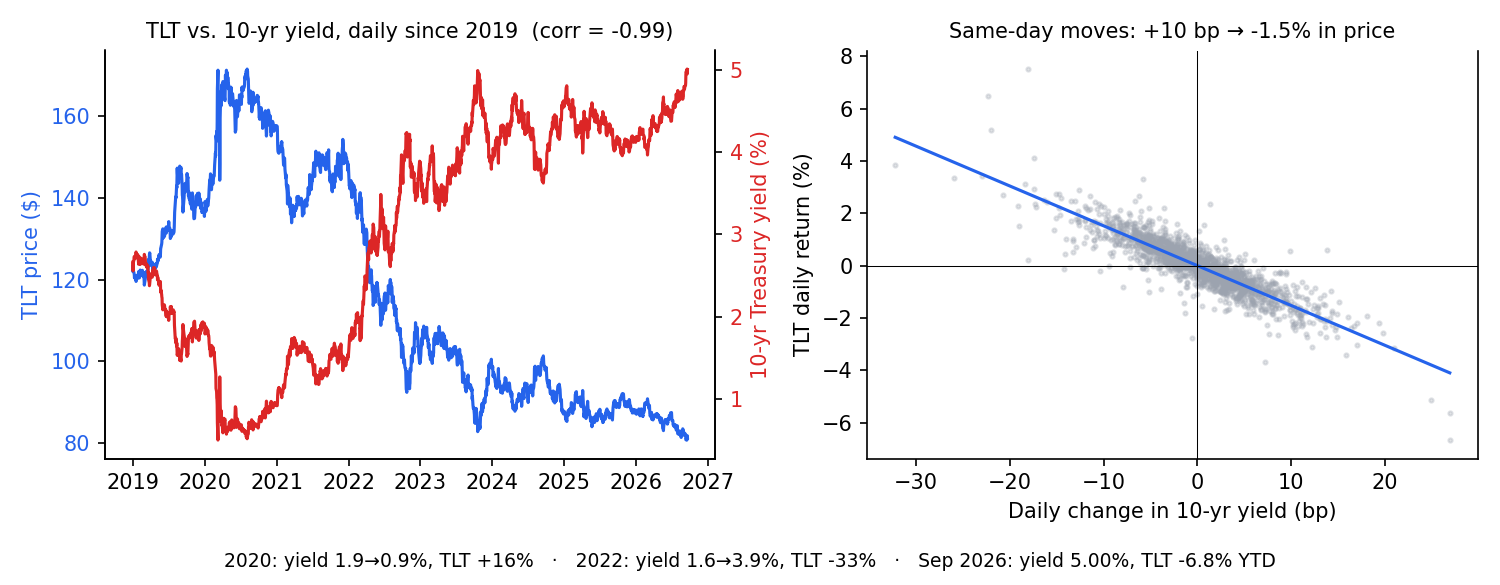
Bond Prices and Interest Rates
Case: the 10-yr Treasury at 5% — Sep 18, 2026
The yield quoted in the news is a YTM, solved out of the note’s market price — nobody sets it. (≠ fed funds, which the FOMC does set: hiked 25 bp to 3.75–4% on Sep 16, 2026.)
| Effect | |
|---|---|
| 10-yr note, | |
| 30-yr issued 2020, | |
| 30-yr mortgage | 6.76% → 6.95% in a week (tracks the 10-yr, not fed funds) |
| Payment on a | |
| Equities | higher discount rate on future earnings → valuations compress |
| New savers | 5% locked risk-free for 10 yrs |
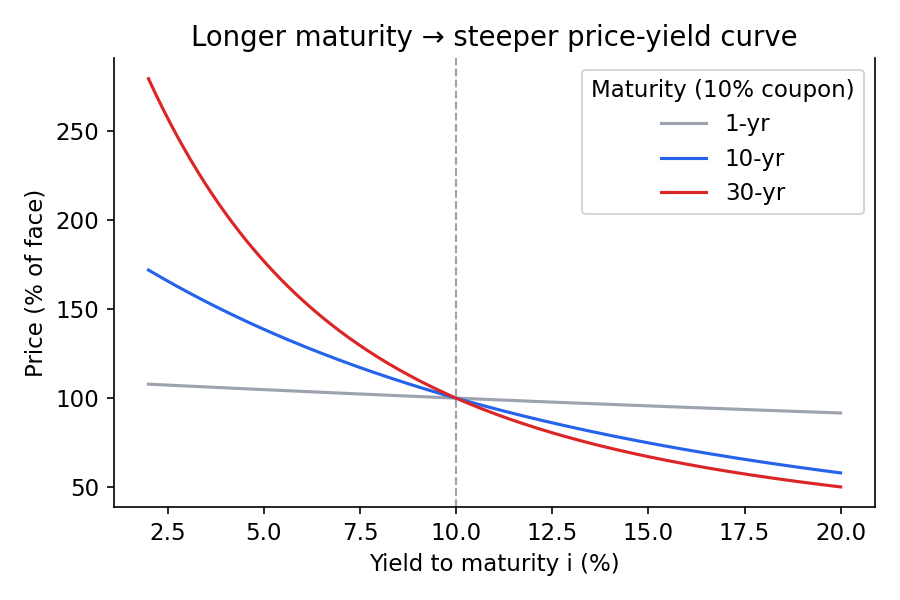
Maturity and the Volatility of Bond Returns
Rate of Return
What you actually earn over the time you hold the instrument: cash collected
Coupon Bond
Fixed-Payment Loan
From the lender’s side:
Annualized Return
Hold
- Compounds, so it is a geometric mean:
give total and /yr. - Periods shorter than a year:
, = periods per year.
The Fisher Equation
The interest rate we have been discussing so far is the nominal interest rate, which makes no allowance for inflation.
The real interest rate (adjusted for inflation) is more accurately defined by the Fisher equation.
When the real interest rate
The lender is paid back in dollars that buy less because of inflation.