Money and Banking (2): What Is Money?
From Frederic S. Mishkin, The Economics of Money, Banking, and Financial Markets — Chapter 3
We use money every day. To economists, money has a very specific meaning. Money is anything that is accepted in payment for goods or services or in the repayment of debts. Currency is one type of money.
Functions of Money
Any type or form of money should have three primary functions in any economy: as a medium of exchange, as a unit of account, and as a store of value.
Medium of Exchange
Money in the form of currency or checks is a medium of exchange. The use of money as a medium of exchange promotes economic efficiency.
Money reduces transaction costs compared with a barter economy.
Unit of Account
A unit of account is used to measure value in the economy.
Store of Value
A store of value is a repository of purchasing power over time. How good a store of value money is depends on the price level. During inflation, money loses value rapidly as the price level rises fast.
Evolution of the Payments System
The payments system has been evolving over centuries: from commodity money, to fiat money, to checks, to electronic payment, and finally to e-money.
The most important step in this evolution is the move to fiat money.
From the 1870s to 1914, major currencies were on the classical gold standard, under which they could be exchanged for a fixed weight of gold. In 1944, near the end of World War II, the Bretton Woods system was established: the dollar stayed tied to gold, and every other currency was pegged to the dollar. In 1971, President Nixon ended the dollar’s link to gold. By 1973 the major currencies were floating, and money is now fiat (paper currency decreed by the government as legal tender).
Measuring Money
To measure money, we need a precise definition of exactly which assets should be included.
The Fed has settled on the following measures of the money supply, called monetary aggregates.
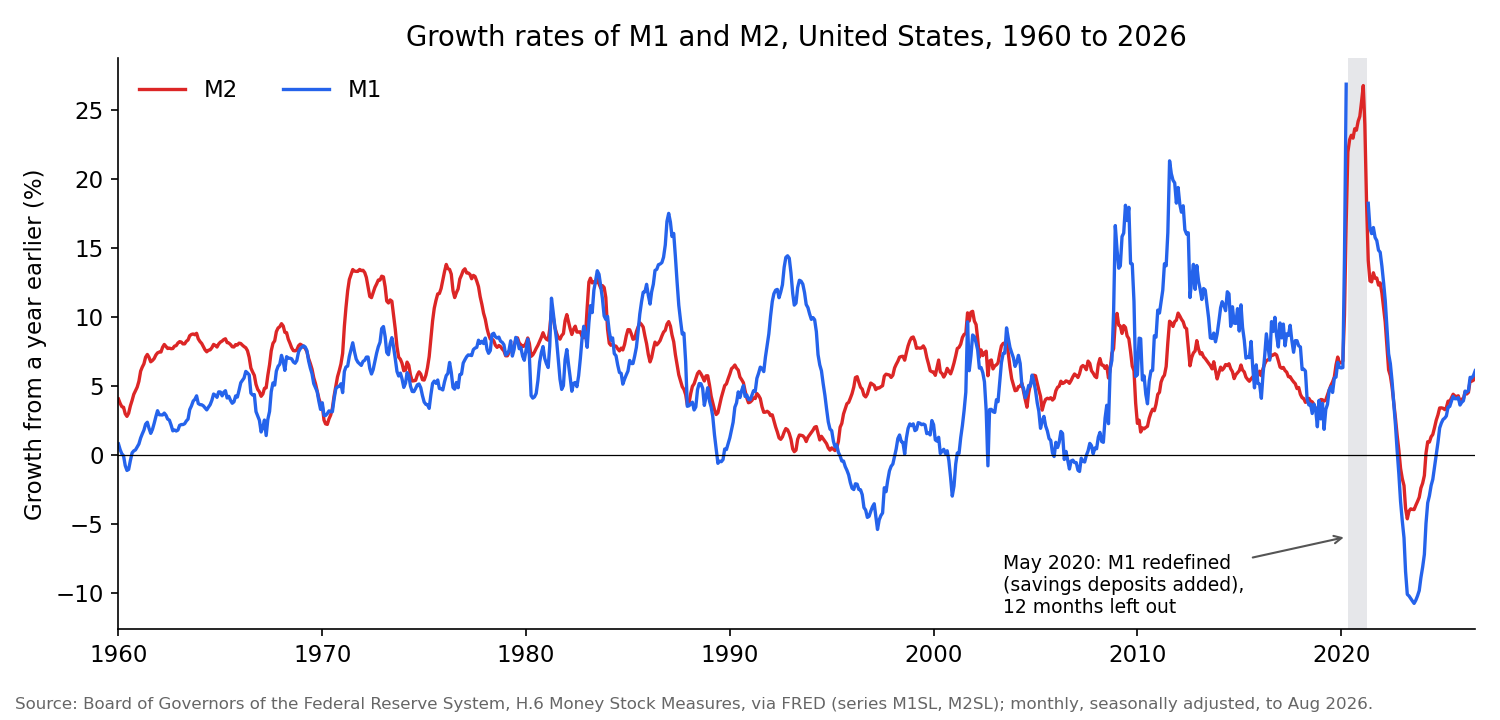
The narrowest measure of money is M1. It includes the most liquid assets: currency, checking account deposits, and savings deposits (including money market deposit accounts).
The M2 monetary aggregate adds other assets that are not quite as liquid as those in M1. Those assets are small-denomination time deposits (a type of CD, under $100,000) and retail money market mutual fund shares.
Savings deposits counted only in M2 until May 2020, when the Fed moved them into M1.